Group Trip Budget: How to Agree on Money Before You Book
Talk money before you pick a destination: a per-person ceiling, shared costs and cancellation rules. A practical guide to budgeting a trip with friends.
Table of Contents
- Talk budget before you pick a destination
- Set a per-person ceiling
- Decide what’s included
- Plan a buffer and optional activities
- Check each person’s total, not just the shared part
- Who pays for what: set the rules before you book
- Agree on the amounts
- Decide who fronts the money, who pays back, and by when
- Plan for one person dropping out
- Bachelor and bachelorette parties
- Check a deal as a group: total price, dates, cancellation
- Read the total price, not the headline price
- Make sure the dates work for the whole group
- Check fees and what’s not included
- Read the cancellation terms and how long the deal lasts
- Only book once the group’s framework is set
- How Bangertrip can help your group
- Frequently asked questions
- How do you agree on a budget for a trip with friends?
- How do you split costs on a group trip?
- Who pays for what on a group trip?
- How do you make a budget for a group trip?
- How much should you budget for a weekend trip with friends?
- What should you check on a Black Friday travel deal?
- How do you collect money for a group trip?
- What is the best app for a group trip budget?
To budget a trip with friends, talk about money before you pick a destination. Agree together on a per-person ceiling, what it covers, a buffer and which activities are optional. Settle who pays for what, the payment deadlines and what happens if someone cancels. Check any deal as a group: total price, dates, fees and cancellation terms.
A trip with friends almost always starts with the fun part: a destination, a few dates, a rental someone found late at night. The budget usually comes later, sometimes right when the deposit is due. That’s where things get stuck: one person thinks it’s too expensive, another doesn’t dare say so, and the plan stalls.
The good news: it doesn’t have to go that way. Talking about money early isn’t awkward when everyone can name their limit without having to explain it. Here’s a three-step method: set the budget framework, agree on who pays for what, then check any deal together.
Booking.com’s 2027 Travel Predictions, published on October 14, 2026, found that “Half of travelers (50%) have reconsidered who to invite on a trip because of differences in spending.” The sample: 28,230 adults across 32 countries and territories who plan to travel for business or leisure in the next 12 to 24 months, surveyed online in July and August 2026 (Booking.com release). It’s a self-reported survey: it reflects what respondents say, not what every group goes through.
The same survey reports a second figure, worth reading on its own: “51% have experienced tension or disagreements during a trip because people had different expectations around money.”
Talk budget before you pick a destination
The order of the conversation changes everything. If you pick the destination first, the budget turns into an entrance exam: whoever can’t keep up has to explain themselves, or stay quiet. If you set the budget first, you look for a destination inside a framework everyone can actually afford.
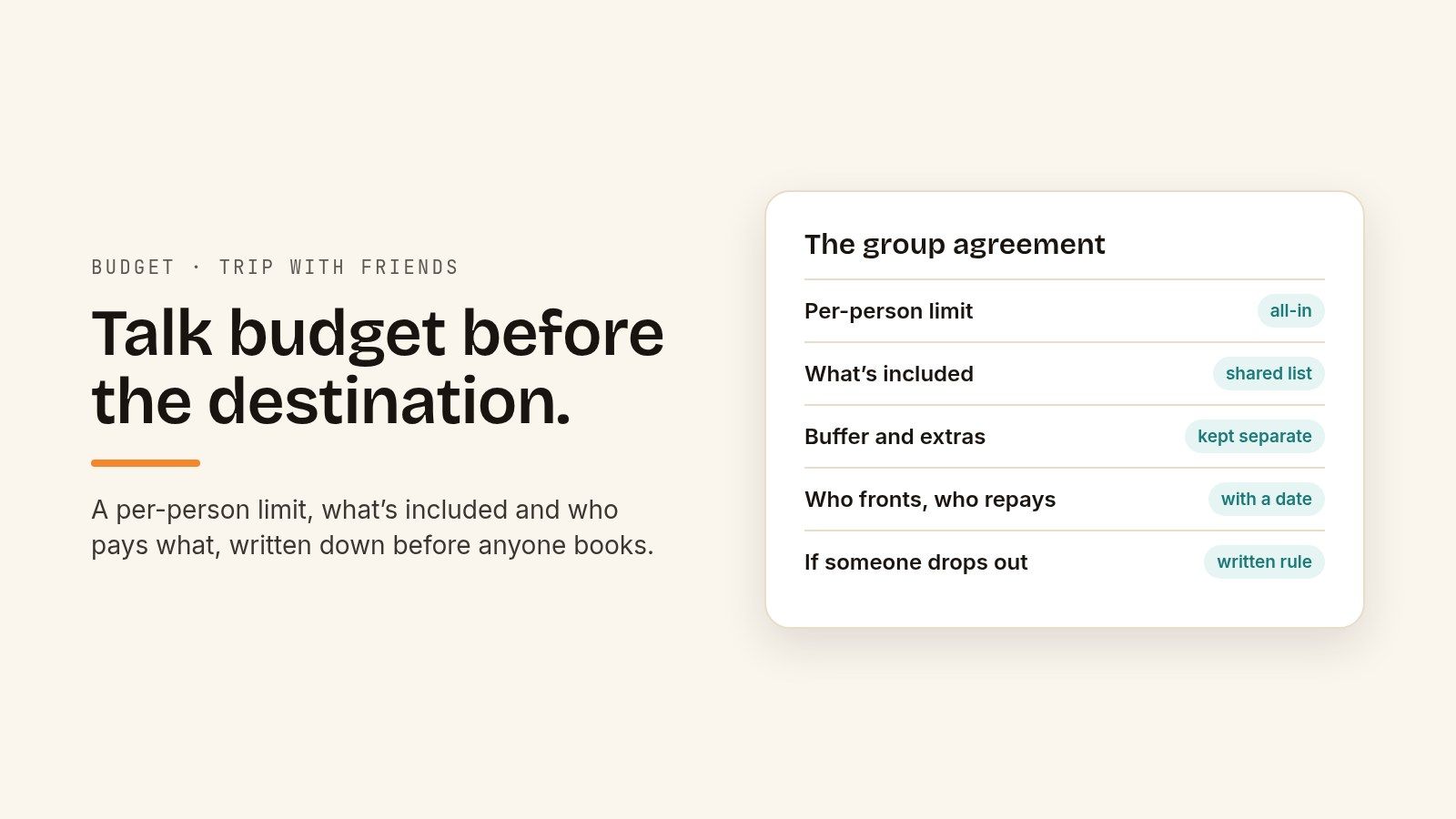
Dates are chosen from when everyone is free, and the group votes on destinations. The budget works differently. Nobody votes on an amount: each person picks one tier from the ranges on offer. Anyone without a particular limit can leave it to the group. The group ceiling is the lowest top end among those who picked a tier, not the most popular one. It’s the only way to go without leaving anyone behind.
Set a per-person ceiling
Think of the ceiling per person and for the whole trip, not for the group: everyone answers the question “How far can you go?” by picking an all-in tier, or leaves it to the group. Nobody has to justify their choice.
Everyone should know this ceiling before anyone browses rentals or compares destinations. Otherwise, the first “perfect” place someone finds ends up setting the budget instead of the group.
Decide what’s included
A ceiling means nothing until you know what it covers. List the trip’s items together: travel, accommodation, food, local transfers, planned activities, and insurance if the group takes some. For each item, ask one question: does it count toward the ceiling?
The simplest rule: anything that isn’t on the list stays personal, unless the group agrees otherwise. Souvenirs, or a last-minute night out for three: everyone handles their own.
Plan a buffer and optional activities
Even a well-prepared budget moves: an unplanned taxi, a dinner that costs more than expected. Plan a buffer, and say clearly what it’s for. That buffer stays in each person’s pocket: it isn’t a pot automatically handed over to the organizer.
Optional activities deserve their own line. A dive or a spa day only commits the people who go. Keeping them out of the shared budget lets everyone say yes or no without any awkwardness. It’s also a good way to keep some time for yourself during the trip.
Check each person’s total, not just the shared part
The shared part (accommodation, car, groceries) is only part of the story: what matters is each person’s total. A friend whose travel costs more has less room for the rest of the trip, even with the same share of the rental.
So before you commit, look at the total per person, travel included. For each item, separate what’s confirmed, what’s still an estimate and what’s optional. Replace estimates with prices you’ve actually checked for your dates as soon as you can. For the full planning process, read our guide on how to plan a group trip before anyone books.
Who pays for what: set the rules before you book
 A map, a camera, photos, a laptop and notebooks on a table, seen from above
Photo: Anirudh / Unsplash
Then comes the question that causes the most friction: who pays for what, and when. There’s no universal rule. What matters is a rule you choose together, write down and share with everyone before the first payment. This guide offers a planning method, not financial or legal advice.
Agree on the amounts
Start with three simple lists: what each person can put in, what’s shared and what stays optional. For a shared rental, pick how to split it: equal shares, by number of nights if not everyone stays as long, or adjusted for how comfortable each room is. The right rule is the one the group accepts before booking. For the mechanics of the split itself, see how to split costs on a group vacation.
Decide who fronts the money, who pays back, and by when
Often one person fronts the deposit or the tickets for everyone. That’s handy, on one condition: nobody should find out afterwards that they’ve been financing the whole group. Write down who fronts what, for whom, how much, and the date by which everyone pays back.
To decide who keeps track of all this, see how to share the planning tasks.
To be clear: during the beta, Bangertrip doesn’t collect money, split payments or track expenses. Paybacks are settled between you, with the tools your group already uses.
Plan for one person dropping out
A friend may pull out. It’s better to talk about it beforehand, calmly, and to separate two moments.
Before booking, a friend leaving mostly changes the number of shares, and sometimes the choice of accommodation. We cover this in detail in our guide on what to do when a friend backs out before booking.
After a deposit, the question becomes: who stays committed to the rental, and what happens to the share of the person who leaves? Agree on the principle in advance. For refundable amounts, the host’s or the insurer’s terms are what count: read them together, exactly as they’re written.
Bachelor and bachelorette parties
A bachelor or bachelorette party raises questions of its own (guests who come for different nights, the share of the person getting married). Our dedicated guides cover them: the bachelor party budget when guests stay different nights, who pays for the bachelorette party, and for overall planning, the bachelor party decisions before booking and how to plan a bachelorette party when expectations differ.
Check a deal as a group: total price, dates, cancellation
In 2026, Black Friday falls on Friday, November 27, the day after Thanksgiving (Thursday, November 26), according to the US federal holiday calendar (OPM). That date is only a marker: a retail calendar doesn’t prove that a deal exists. Bangertrip offers no discounts.
Here’s a checklist to go through as a group, Black Friday or not.
Read the total price, not the headline price
The big number on the screen isn’t always what you’ll pay. Add service fees, taxes, transfers and baggage, and check whether optional insurance is being presented as mandatory. Then compare that total with the group’s per-person ceiling, not with your own budget.
Make sure the dates work for the whole group
A deal on dates that only suit part of the group isn’t a good deal. Check that they match the dates the group picked from everyone’s availability.
Check fees and what’s not included
Read the list of what’s included, then the list of what isn’t: cleaning, linens, parking, security deposit. Anything not included goes back into each person’s total, and so into the ceiling.
Read the cancellation terms and how long the deal lasts
Look at the cancellation and change terms, and at how long the offer is valid. A short promotion shouldn’t push you into booking before the group agrees. If the deal expires before everyone has had a chance to say yes, it’s better to let it go.
Only book once the group’s framework is set
Before anyone clicks “Book,” check three things together: the group ceiling is known, the participants are confirmed, and the rules on who pays for what are written down. Otherwise, even the best deal can create tension.
How Bangertrip can help your group
Bangertrip is for making group decisions before you book. Each participant has their own account, with a quick sign-up from the invitation link, and a trip brings together 2 to 20 participants.
Dates are chosen from when everyone is free, and the group votes on destinations. The budget isn’t put to a vote: everyone answers “How far can you go?” by picking one tier from the ranges the organizer set up, per person and for the whole trip. Anyone without a limit picks the “YOLO, I’ll follow” option, marked “no limit from me.” The group ceiling is the lowest top end among those who picked a tier. For destinations, that’s the Bangertrip promise: Everyone votes, the group decides, and you’re off.
What Bangertrip isn’t: an expense tracker or a payment app. During the beta, no payments happen in the app. The app is in private beta: you get in by invitation. Leave your email on the beta page to join the beta.
Frequently asked questions
How do you agree on a budget for a trip with friends?
Talk about it before you pick a destination. Each person picks one tier from the ranges the organizer set up, or chooses to follow the group. The group ceiling is the lowest top end among those who picked a tier, not the most popular one. List what is included and a buffer, then look for a place to stay.
How do you split costs on a group trip?
Separate shared costs (usually the accommodation and some of the travel) from personal spending and optional activities. For a shared rental, the group picks its rule: equal shares, number of nights or room comfort. Write down who paid, for whom, and when they get paid back, before anyone pays the deposit.
Who pays for what on a group trip?
There is no single rule. Before booking, put a written agreement in place with the group: what is shared, what stays optional, who fronts the money, when everyone pays back and what happens if someone cancels. Bachelor and bachelorette parties raise their own questions, covered in our dedicated guides.
How do you make a budget for a group trip?
List every item: travel, accommodation, food, local transfers, planned activities and a buffer. For each one, note whether it is confirmed, still estimated or optional. Replace estimates with prices you actually checked for your dates. The budget that matters is the total per person, travel included, not just the share of the rental.
How much should you budget for a weekend trip with friends?
No typical amount is given here: it depends on the destination, the length of the trip, each person’s travel costs and what is included. List the items, work out the total per person and add a buffer. Then replace each estimate with prices checked for your dates and compare it with the group ceiling.
What should you check on a Black Friday travel deal?
November 27, 2026 is a calendar marker, not proof that a deal exists. Check together the total price, dates that work for the whole group, fees not included, cancellation terms and how long the offer lasts. A deal that expires before the group agrees is not a good deal. Bangertrip offers no discounts.
How do you collect money for a group trip?
First agree on the ceiling and on what the shared pot covers, for example the rental deposit or shared activities. Only then pick a channel the group already uses. Keep track of payments in and the balance. During the beta, Bangertrip does not collect payments and offers no shared pot. This is not financial advice.
What is the best app for a group trip budget?
Agreeing on the framework is not the same as tracking expenses. Bangertrip, in private beta, helps 2 to 20 participants pick dates from everyone’s availability and vote on destinations, each with their own account. Everyone picks a budget tier: the group ceiling is the lowest top end picked. No payments happen in the app during the beta.
Ready to set the framework with your group? Join the beta
Written with the help of AI tools, checked by the BangerTrip Team. Who writes for BangerTrip?