Thanksgiving travel 2026: a group checklist for arrivals, meetups and the last mile
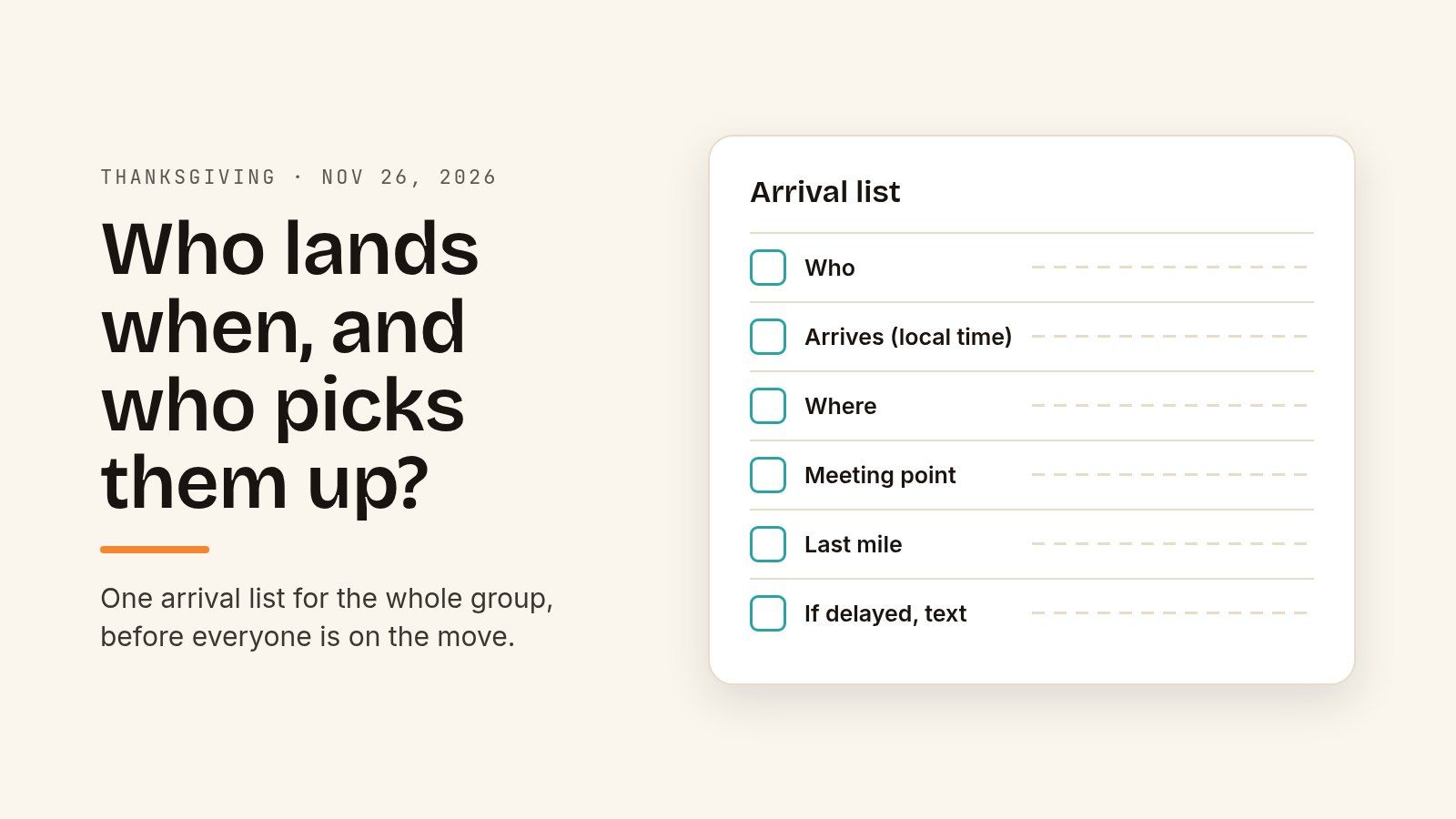
Thanksgiving 2026 is Thursday, November 26. Build one arrival list for your group: local times, meeting points, the last mile, ID and a few agreed check-ins.
Table of Contents
- Thanksgiving 2026: the dates and numbers to know
- Start with the date, then confirm personal availability
- Build one arrival list with useful details
- Give every arrival a last-mile plan
- Choose meeting points people can actually find
- Check ID and each journey on its own terms
- Keep contact details private and check-ins proportionate
- Your final Thanksgiving checklist
- How Bangertrip can help your group
- Frequently asked questions
- When is Thanksgiving 2026?
- What are the busiest days to travel for Thanksgiving?
- How do you coordinate arrivals for a group trip?
- What ID do you need to fly for Thanksgiving?
- How should a group stay in touch on Thanksgiving travel day?
- What should be on a Thanksgiving group travel checklist?
Thanksgiving 2026 falls on Thursday, November 26. To coordinate a group trip, make one shared arrival list: each person’s local arrival time, place, meeting point and last-mile ride to where you’re staying. Add a plan for delays, an acceptable ID for anyone flying, private contacts, and a few agreed check-ins rather than constant messages.
Thanksgiving travel often brings a group together from several starting points. One person drives after work, another flies in the next morning, and someone else can only stay for dinner. A good plan makes those differences easy to handle.
The key is to record each person’s actual journey and decide what happens after they arrive. You don’t need a minute-by-minute schedule for the whole holiday.
Thanksgiving 2026: the dates and numbers to know
- Thanksgiving Day is Thursday, November 26, 2026, according to the U.S. Office of Personnel Management’s 2026 federal holiday schedule, checked on November 11, 2026.
- The roads carry most of the trips. For Thanksgiving 2026, AAA projects 81.5 million people traveling at least 50 miles from home between Tuesday, November 24 and Monday, November 30, a 0.1% decline from the 81.6 million who traveled in 2025, ending a three-year streak of record Thanksgiving travel. Of those, 72.9 million are expected to travel by car, 5.96 million by domestic flight, and 2.6 million by bus, train or cruise. Roundtrip domestic flights are averaging $800, 17% more than last year (AAA forecast, November 16, 2026).
- Airports peak after the holiday. On Sunday, November 30, 2025, TSA screened 3,134,613 people, according to its 2025 passenger volume table. That’s the highest daily total in TSA’s 2025 table.
The 2026 forecast still shows the pattern to plan around: departures spread over several days, and a heavy return at the end of the weekend. INRIX, cited in the same forecast, expects the busiest days on the road to be Tuesday and Wednesday as people leave, and Sunday and Monday when they return; the worst traffic is in the afternoon and early evening, so a morning departure helps.
Start with the date, then confirm personal availability
The holiday date doesn’t tell you when everyone is off work or when a school break starts. Ask each traveler for their earliest possible arrival, latest possible departure, and any plans that are still waiting for approval.
If you’re staying together, identify the nights each person will use the accommodation. Decide how different lengths of stay affect shared costs before anyone books: our group trip budget guide covers per-person caps and who pays for what, and how to split costs on a group vacation covers the split itself. For the earlier decisions, see how to plan a group trip before anyone books.
Build one arrival list with useful details
Record the information needed to coordinate, rather than every detail on a booking confirmation:
- Traveler or household name.
- Arrival date and local time.
- Airport, station or other arrival location.
- Flight or train number when useful for checking status.
- The onward plan to the accommodation or host’s home.
- Whether that plan is booked, agreed or still undecided.
Make time zones explicit when people are traveling across them. A landing time is also different from the time someone will be ready for pickup: allow for baggage collection and the walk to the pickup area.
Pick one person to keep the list current when plans change. Updating the main list is more useful than leaving a correction buried in a busy conversation. To decide who does what, see how to share the planning tasks with friends.
Give every arrival a last-mile plan
For each traveler, answer one practical question: how do they get from their arrival location to the place they’re staying?
If someone offers a ride, confirm who is driving, how many people and bags can fit, and where pickup will happen. Agree what the traveler should do if a delay makes that pickup impractical.
For public transport, check the timetable for the actual holiday date and expected arrival time. Don’t assume the usual weekday schedule applies. If you’re considering a paid ride, agree who is arranging it and how the cost will be handled.
Confirm access at the destination too. A traveler arriving after everyone has gone out should know whom to contact and whether entry has been arranged. Share door codes only privately with the people who need them.
Choose meeting points people can actually find
“Meet outside” isn’t enough at a large airport or station. Agree on a specific, permitted pickup area or another clearly identifiable place. Recheck the location if the terminal, platform or arrival arrangements change.
For a group meeting after separate journeys, choose a place where waiting is practical and agree on a time window. Make it clear whether early arrivals should wait there or head to the accommodation.
If a late arrival means missing the first meal, make a separate plan with that person. The rest of the group doesn’t need to stay in transit mode until the final traveler arrives.
Check ID and each journey on its own terms
Adult travelers need an acceptable ID at the airport checkpoint. REAL ID enforcement began on May 7, 2025, and TSA states that travelers without an acceptable ID, such as a passport or REAL ID, can pay a $45 fee to use TSA ConfirmID, with no guarantee their identity can be verified (TSA REAL ID and TSA ConfirmID pages, checked on November 11, 2026). Ask everyone to check their ID before the trip, not at the airport.
There is no single airport arrival time that fits every traveler. Follow the airline and airport guidance for the specific departure, taking account of baggage, check-in deadlines, assistance needs and the route involved.
Shortly before travel, verify transport status, destination access and any arrangements with the host. Check the forecast for the actual journey rather than assuming seasonal weather will tell you what to expect.
Keep contact details private and check-ins proportionate
Share a host’s phone number, home address or access instructions only with the travelers who need them. Keep personal details out of any public itinerary or social post, and keep booking references and identity documents out of broad group messages.
Agree on a few useful check-ins: when a delay changes pickup plans, when a traveler reaches the agreed meeting point, and when they arrive at the destination if they want to confirm it. Constant location sharing isn’t necessary for a well-organized trip.
Drivers should send updates only when safely stopped. If a message is late, use the agreed contact plan rather than asking the whole group to chase the traveler.
If someone has to cancel at the last minute, settle what happens to their share calmly and separately. Our guide on what to do when a friend backs out covers the before-booking case.
Your final Thanksgiving checklist
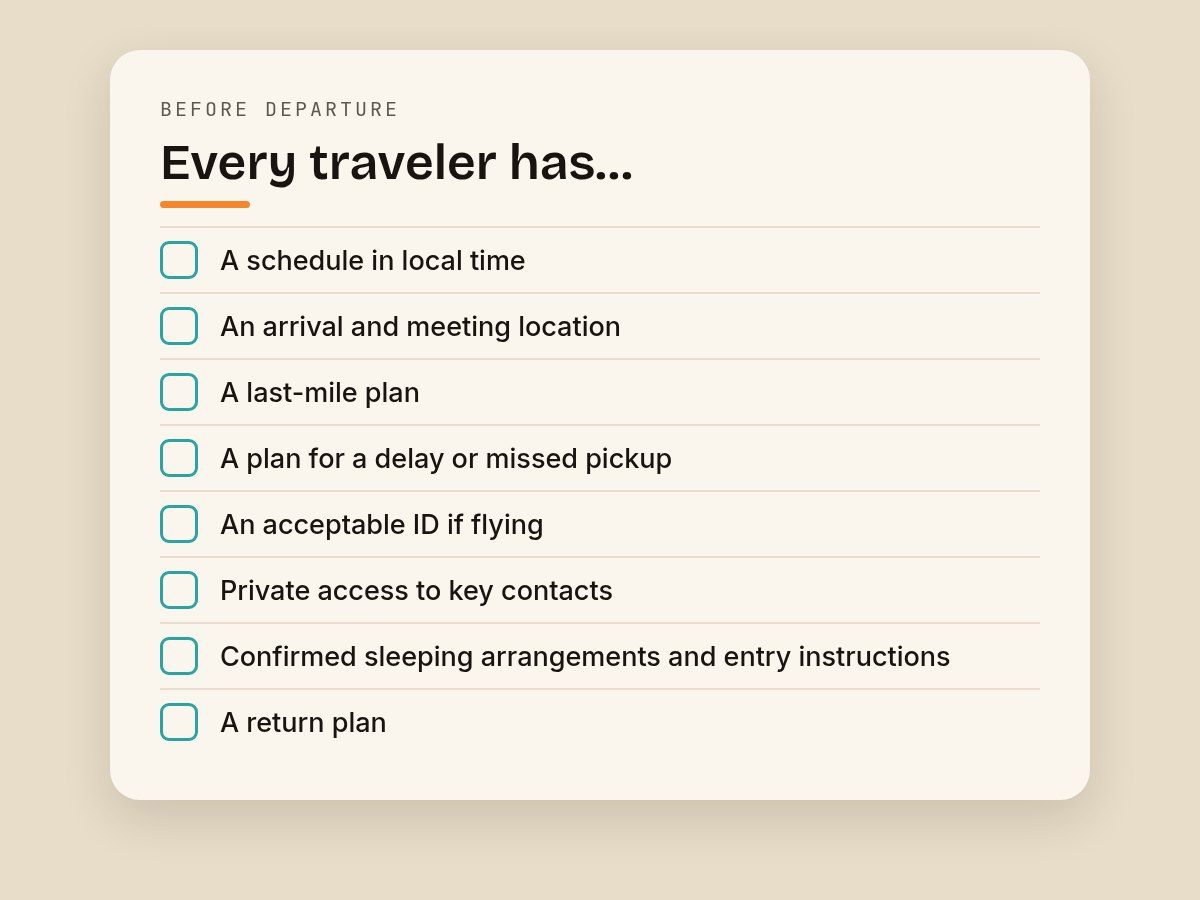 Checklist card titled “Every traveler has…” with empty boxes for a schedule in local time, an arrival and meeting location, a last-mile plan, a delay plan, an acceptable ID, private contacts and confirmed sleeping arrangements and entry instructions, and a return plan
Before departure, confirm that every traveler has:
- An accurate schedule with local times.
- A clear arrival and meeting location.
- A workable last-mile plan.
- A plan for a delay or missed pickup.
- An acceptable ID if they’re flying.
- Private access to the contacts they need.
- Confirmed sleeping arrangements and entry instructions.
- A return plan that fits their own commitments.
Keep optional activities flexible around arrivals and departures. Once the practical details are clear, the group can spend less time coordinating and more time together. And if anyone needs a break during a long weekend, here’s how to make time for yourself on a trip with friends.
How Bangertrip can help your group
Bangertrip is for making group decisions before you book. Each participant has their own account, with a quick sign-up from the invitation link, and a trip brings together 2 to 20 participants. Dates are chosen from when everyone is free, and the group votes on destinations, so the question “who can come when?” is settled before anyone buys a ticket. Everyone shares their availability, the group decides, and you’re off.
Bangertrip doesn’t book transport or replace your arrival list. During the beta, no payments happen in the app. The app is in private beta: you get in by invitation. Leave your email on the beta page to join the beta.
Frequently asked questions
When is Thanksgiving 2026?
Thanksgiving Day 2026 is Thursday, November 26, according to the U.S. Office of Personnel Management’s federal holiday schedule. Many travelers leave earlier in the week and return over the weekend, so confirm each person’s own days off before you set a group arrival plan or book a shared place to stay.
What are the busiest days to travel for Thanksgiving?
According to INRIX, cited in the AAA forecast, November 16, 2026, the busiest days on the road are Tuesday and Wednesday as people leave, and Sunday and Monday when they return. The worst traffic is in the afternoon and early evening, so a morning departure helps.
How do you coordinate arrivals for a group trip?
Make one shared arrival list: each person’s name, local arrival time, arrival place, flight or train number if useful, and the last-mile plan to where you’re staying. Mark each plan as booked, agreed or undecided. One person keeps the list current, and the group agrees on what to do if someone is delayed.
What ID do you need to fly for Thanksgiving?
To fly from a U.S. airport, TSA requires adult travelers to show an acceptable ID, such as a REAL ID or a passport; enforcement began on May 7, 2025. TSA says travelers without one can pay a $45 ConfirmID fee, with no guarantee their identity will be verified. Check the TSA website and your ID before the trip.
How should a group stay in touch on Thanksgiving travel day?
Agree on a few check-ins rather than constant messages: when a delay changes a pickup, when someone reaches the meeting point, and when they arrive if they want to confirm. Share addresses, door codes and host contacts only privately with those who need them. Drivers should only reply when safely stopped.
What should be on a Thanksgiving group travel checklist?
For each traveler: a schedule in local time, an arrival and meeting location, a last-mile plan, a plan for delays or a missed pickup, an acceptable ID if flying, private access to key contacts, confirmed sleeping arrangements and entry instructions, and a return plan. Keep optional activities flexible around arrivals and departures.
Getting the group to agree on dates before anyone books? Join the beta
Written with the help of AI tools, checked by the BangerTrip Team. Who writes for BangerTrip?